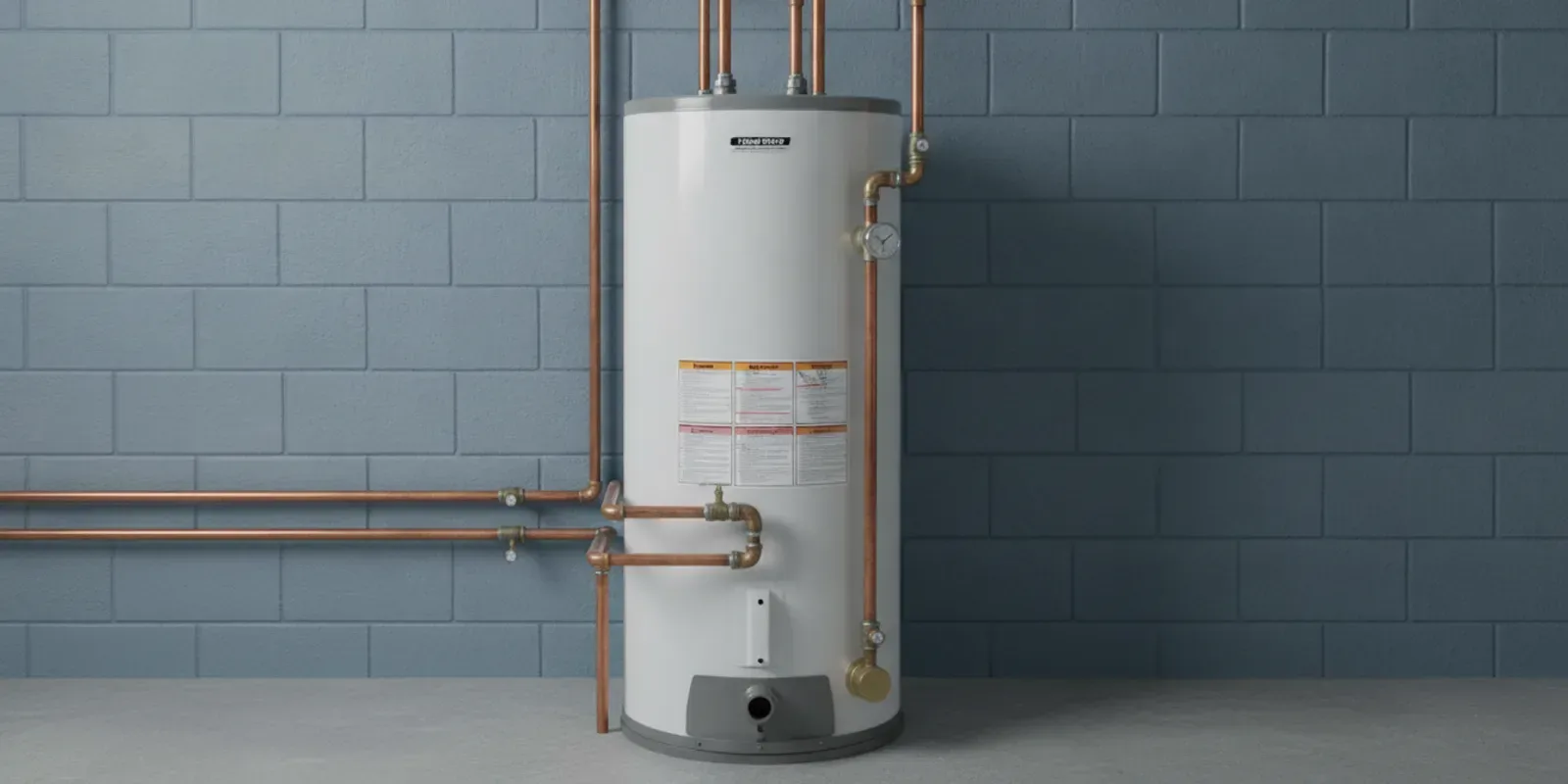
A 40 gallon water heater may be a reasonable option for one home and a poor fit for another. Tank capacity alone cannot tell you whether hot water will keep up with your household, whether the current equipment is working properly, or whether a replacement will suit the property. Before choosing a model, look at your actual routines and the installation conditions that need to be checked.
Request an estimate for planned replacement work
What does a 40 gallon water heater tell you?
The number describes the tank's stated storage capacity. It does not, by itself, tell you how much hot water your household will have at a particular moment, how quickly the unit can recover after use, or whether the appliance and its connections suit your building. Those are separate questions to review when comparing replacement options.
Two households with the same number of occupants may have very different routines. One may use hot water at different times throughout the day. Another may have several showers, laundry, or dishwashing close together. The property also matters: an individual home, a condo, and an apartment building can present different access and equipment constraints.
For that reason, treat 40 gallons as a starting point for assessment, not as a household-size rule or a promise of comfort. A replacement with the same stated capacity might be worth discussing if the current system has served the household well, but a like-for-like choice should not be automatic.
How can you review your household's hot-water routine?
Start with the busiest part of a typical day. Think about when people shower, when laundry or dishwashing happens, and whether these uses overlap. The aim is not to calculate an engineering specification at home. It is to give the plumbing professional a clear picture of what the equipment is being asked to do.
- Write down the busy periods. Note whether demand clusters in the morning, evening, or another predictable window.
- Describe overlapping uses. Record when showers and appliances are likely to run close together, rather than listing only the total number of residents.
- Separate routine from unusual events. A holiday gathering or one-off laundry day may not represent everyday use. Note both, but identify which is typical.
- Track when the problem occurs. If the water runs cool, record the time, what was running, and whether the issue repeats under similar conditions.
For example, imagine that one household reports that hot water is usually available, but several people use showers one after another before work. That is more useful than saying only that the home has a certain number of residents. In another home, the complaint may occur at scattered times, even when there is no obvious overlap. Those patterns call for different questions during an assessment; neither one proves that a larger tank is the answer.
Include changes that may affect future use. A new household member, a change in work schedules, or a planned bathroom or kitchen project can make today's routine a poor guide to expected demand after the work. Explain what is changing so the decision reflects the home you intend to use, not just its current week.
Could a performance problem be mistaken for a sizing problem?
Repeatedly running short of hot water is worth investigating, but it does not establish the cause. A tank's condition, a change in how it performs, an issue elsewhere in the system, or a mismatch between demand and available capacity could all be part of the discussion. Avoid buying a larger unit based on one symptom before the existing setup has been considered.
Keep a simple record for several occurrences if the issue is not urgent. Include how long the water stayed hot, the fixtures or appliances in use, whether the problem affected one area or the whole property, and whether it began suddenly or gradually. If the issue followed a recent repair, renovation, or change in equipment, include that detail.
Do not remove covers, disconnect pipes, move a tank, or adjust unfamiliar controls to collect information. If you are trying to understand an immediate loss of hot water, the company's hot water heater repair guide discusses initial checks. Leave electrical, gas, and plumbing work to qualified professionals.
A useful question at the visit is: “What evidence points to a capacity mismatch, and what else have you ruled out?” Ask the technician to explain what was observed, what the proposed work would address, and whether any follow-up diagnosis is needed. A clear explanation helps distinguish a replacement recommendation from a repair or troubleshooting recommendation.
What should you compare before selecting a replacement?
Compare options by the problem they are meant to solve and by whether the property can support them. Do not compare units by the gallon label alone. The best questions are specific to your existing equipment, your routine, and the conditions a site visit can confirm.
Keeping a similar tank capacity
A similar-capacity replacement may be one option to discuss when the existing setup has generally met the household's needs and the routine has not changed. Ask whether the current unit's behavior supports that choice, and whether the replacement arrangement fits the property's actual connections and available space. Similar capacity does not necessarily mean every other installation detail is identical.
Considering a different capacity or configuration
If hot water regularly runs short during ordinary use, or demand has changed, ask what alternatives are appropriate and what trade-offs matter. A different capacity or equipment configuration should be proposed only after considering the actual system and the conditions at the property. Do not assume that moving up in capacity alone will resolve a performance issue or that a particular alternative will fit without changes.
Repairing or diagnosing the current system first
If the current system's performance changed recently, the first question may be whether it needs diagnosis rather than immediate replacement. Ask what can be inspected, what the findings indicate, and whether repair is a reasonable path to consider. If replacement is recommended, ask which observed conditions make repair unsuitable or less appropriate for this case.
These are comparison categories, not a universal ranking. The right choice depends on findings at the home. The U.S. Department of Energy provides general consumer information on energy use at its official website; consult authoritative guidance for broader context, while relying on a site-specific assessment for the equipment and installation questions in your home.
Which property details should be checked?
A tank has to work within the real space and system available. Before selecting a replacement, make sure the assessment considers the equipment now serving the property and any limits that could affect removal, delivery, installation, or future service access. A photograph of the area may help with an initial conversation, but it does not replace an on-site review where one is needed.
- Space and access: Identify where the heater is located, how a technician can reach it, and whether doors, stairs, or shared areas affect access. Do not try to move the unit yourself.
- Existing connections: Have the visible model and capacity information available if it is easy and safe to read. A professional should confirm the relevant connections and what work may be needed.
- Building coordination: In a condo or multifamily property, establish who can authorize work, who controls shared areas, and how access or any planned shutdown would be coordinated.
- Project conditions: Ask whether permits, filings, or other property-specific requirements affect the proposed scope, price, or timing.
- Scope boundaries: Confirm whether the proposal covers only the heater or also includes related piping or other work, and ask what would be treated separately.
These details matter in New York City properties where a unit may be located in a shared mechanical area or reached through managed building spaces. A resident may not have authority to arrange work on shared equipment. Owners, managers, or supers should clarify responsibility and access before a replacement date is discussed.
What should you prepare for a replacement assessment?
A little preparation can make a site visit more useful. Gather information that is safe and readily available; you do not need to diagnose the heater yourself. A concise account of the problem and the property's constraints is more helpful than a guess about the exact model to buy.
- Describe the current heater. Share its visible label information if accessible, approximate age only if known, and whether it has been repaired or altered. Do not estimate or state details as fact if you are unsure.
- Explain normal demand. Note the typical number and timing of hot-water uses, including recurring overlap and any likely near-term changes.
- Report the symptom precisely. Say whether water is not heating at all, runs out at a predictable time, or has an intermittent issue. Include when it began and how often it happens.
- Identify the decision-makers. For a managed property, confirm who approves work and who can arrange entry to the unit or mechanical area.
- Ask for a written scope. Have the proposed equipment and work, exclusions, any related work, and project-specific conditions explained before you decide.
Nonstop Plumbers provides water heater installation and repair. A planned replacement may need a site visit and estimate; price and timing depend on the actual conditions and any filing requirements. There is no universal price or timeline that can be confirmed from tank capacity alone. The company-wide plumbing services overview is another way to review service categories, but it does not substitute for a scope for your particular property.
When should you call instead of planning a replacement?
If hot water has stopped in a building, or there is an active leak, flooding, or another time-sensitive plumbing issue, call emergency dispatch rather than waiting for a general contact form. If it is safe, shut off the affected fixture or nearest water source. Keep people away from affected areas, and notify building staff in a multifamily property so they can coordinate access and any common-area shutdowns.
Call (212) 567-2000 for 24/7 emergency dispatch. Dispatch availability does not promise a fixed arrival time; routing and arrival depend on conditions, access, traffic, and current volume. Do not operate unfamiliar common-area valves or attempt work on the equipment yourself.
For non-urgent planning, use the contact page to request an estimate. The form is for planned work and estimates, not a confirmed appointment. Make clear whether the request concerns a private home, a condo, or shared building equipment so the right access and decision-making questions can be addressed.
Request an estimate for a planned water heater replacement
Frequently asked questions
Is a 40 gallon water heater enough for a family?
It depends on how and when hot water is used, the condition and performance of the existing system, and what the property can support. Household size alone is not enough to confirm a suitable capacity.
Should I replace my current tank with the same capacity?
Not automatically. A similar capacity may be worth discussing if the current setup has met your needs, but recurring shortages, changed routines, or a recent performance change are reasons to assess before choosing.
Can I choose a replacement based on the label on my current tank?
The label can provide useful equipment information, but it does not confirm the cause of a problem or establish that the same capacity is right for the replacement. Share the information with the plumbing professional and ask how it relates to the observed demand and site conditions.
Can I get a replacement price without an assessment?
A project-specific estimate may require a site visit because equipment, access, and filing requirements vary. Contact the company about planned work and ask what information is needed to define the scope. The estimate is not confirmed by submitting a form alone.
What if hot water stopped working today?
If the loss affects a building or there is an active leak or other urgent condition, call dispatch at (212) 567-2000 rather than waiting for a form response. Do not assume a specific arrival time.
What is the next step?
Use your notes about daily demand, recurring shortages, and the existing installation to guide a site-specific discussion before selecting a 40 gallon water heater. For planned replacement work, request an estimate and confirm the scope for your property; for an urgent loss of hot water, call (212) 567-2000.