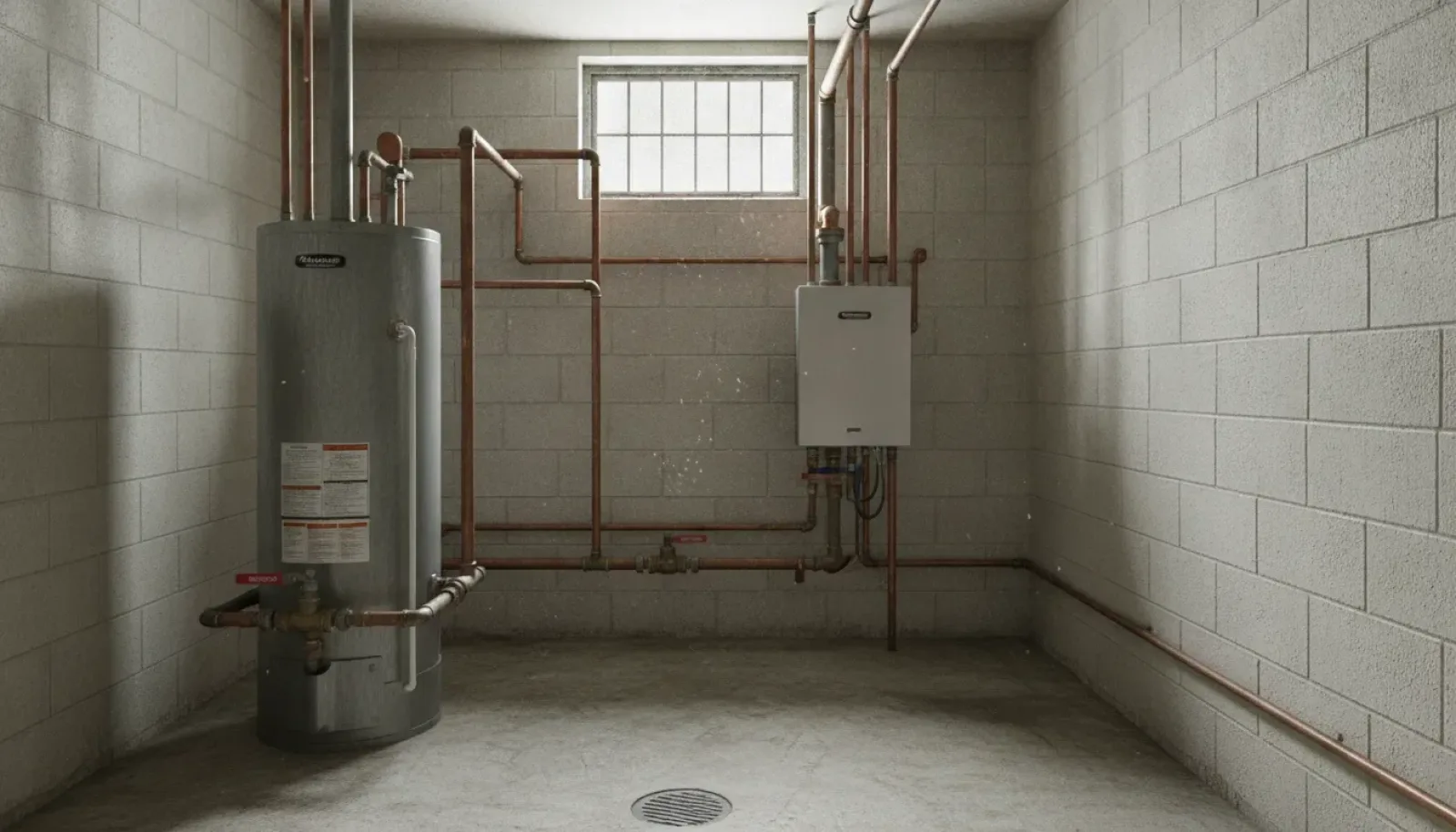
A tankless vs tank water heater for an apartment building is a property decision, not a catalog pick. A storage tank holds a limited supply of heated water. A tankless unit heats water as it flows. The better fit depends on peak use, the room, the fuel, and the vent. It also depends on whether New York City requires a central hot-water source for that building.
Call (212) 567-2000 to review a tank or tankless water heater
Homeowner comparisons often stop at floor space and a household energy bill. A super, property manager, or owner has a different problem. One undersized heater can leave upper floors short during the morning rush. One oversized replacement can demand a gas line, vent, or electrical service the room does not have. The next step is a site review of the system you have. It is not a promise that one equipment type wins everywhere.
How a tank and a tankless heater serve an apartment building
A storage water heater keeps a tank of water hot so several fixtures can draw from it at once. When that stored water is used up, people wait while the heater recovers. Recovery speed depends on the heater input, the incoming water temperature, and the tank size. In a small building, one or more storage heaters can cover ordinary showers, sinks, and laundry. That only works if the tank volume and recovery match the busiest hour.
A tankless, or demand, heater has little or no stored hot water. It fires when water flows and stops when the flow stops. That avoids the cost of keeping a large tank hot overnight. It does not remove the need to size the unit. If several showers open at once, the combined flow can exceed what one heater can raise to a usable temperature. Cold incoming water in winter makes that limit tighter. The heater must add more heat to each gallon.
Apartment buildings also use layouts a single-family guide rarely mentions. Some properties have one central plant that feeds every line. Others have a heater for a group of apartments, or a small heater inside a unit. A central plant is easier for staff to inspect in one place. Unit heaters can limit a failure to one apartment. They also multiply venting, gas, access, and service visits. Neither layout is automatically allowed. The existing approval and the building decide which paths are even open.
What NYC requires before the equipment type matters
New York City's Housing Maintenance Code sets a hot-water duty that comes before brand or style. In a multiple dwelling, every bath, shower, washbasin, and sink in a dwelling unit needs hot water from 6 a.m. to midnight. The code sets a constant minimum of 120 degrees Fahrenheit from a central source. A bath or shower with an approved mixing valve may discharge cooler water. It still cannot go below 110 degrees Fahrenheit. The source has to meet the building code and the department's rules. Read the duty in NYC Administrative Code section 27-2031.
Individual gas or electric heaters can replace that central source only in cases the code allows. The unit must have been lawfully in use on July 14, 1967. Or it must be approved for a building erected, converted, substantially rehabilitated, or fully vacated after that date. Splitting one central plant into many apartment heaters is not a weekend swap. It needs the approvals that apply to that building.
The plumbing code adds a second layer. Water heaters and their safety devices fall under the New York City Plumbing Code chapter on water heaters. Fuel, vent, and electrical work follow the codes for those trades. Oil, gas, and electric equipment are not interchangeable on the same filing. Nonstop Plumbers coordinates permitted water-heater work under NYC Master Plumber Licence #1332. This comparison cannot say whether a specific heater, vent, or gas change will be approved. That answer comes from the site and the filing path.
Tankless vs tank water heater choices for an apartment building
Use the building's peak hour, not one apartment's average day. Count the showers, kitchen sinks, and laundry that can run together on a weekday morning. Then look at where the heater sits and what is already connected to it. A storage tank that meets the recovery need may still be the practical choice. The room may not accept a larger gas line or a new vent. A tankless plant may fit the room and still fail the building. Winter inlet water can push the flow limit too low.
Storage tank and tankless at a glance
How hot water is supplied. A storage tank: Draws from a heated tank, then recovers. A tankless heater: Heats water as it flows.
What runs out first. A storage tank: Stored volume during a long peak. A tankless heater: Flow capacity when many fixtures open.
Space and access. A storage tank: Needs floor space, a drain, and room to service the tank. A tankless heater: Often wall-hung, but still needs clearance and a vent.
Fuel and utilities. A storage tank: Uses the gas, oil, or electric supply sized for that input. A tankless heater: Can need a larger gas line or electrical service.
Standby operation. A storage tank: Keeps stored water hot between uses. A tankless heater: Little stored water, so less standby heating.
Maintenance access. A storage tank: Tank, anode, relief valve, and leak checks in one place. A tankless heater: Scale, filters, and vents. Several units multiply visits.
Do not treat one bad morning as proof the equipment type is wrong. Ask which floors lost hot water, how long it lasted, and what else was running. Laundry stacked on the morning showers can look like a failed heater. A closed valve on one riser can look like a building-wide shortage. Write those notes down before the visit. The comparison should start from the real peak, not from the loudest complaint.
Published homeowner prices are a poor guide here. A house estimate does not include after-hours access or a flue that has to be rebuilt. It also skips a shutdown plan for occupied apartments. Nonstop Plumbers does not publish a flat price for this comparison. The proposal comes after someone sees the heater, the fuel supply, the vent, and the path in and out.
Where demand and temperature decide the equipment
Storage looks stronger when the building can accept a tank large enough for the peak. The heater also has to recover before the next rush. It looks weaker when the tank sits in a room that floods, or when recovery is already too slow. A leaking tank is a replacement problem, not a debate about future efficiency. Short showers in the morning, with hot water back by noon, often point to recovery or tank size. No hot water at all points to a failed heater, a fuel problem, or a control. That is a repair question, not a product debate.
Tankless looks stronger when the room is tight and standby loss matters. The fuel supply still has to support the input at the winter incoming temperature. It looks weaker when the gas meter, pipe, or electric service cannot feed that input. It also looks weaker when the vent has nowhere to go. Scale matters more on a heat exchanger that sees full flow than on a tank that can be flushed. A building that already struggles with sediment should treat water quality as part of the choice.
Department of Energy Building America guidance makes the same point for people selecting equipment. Start with the hot-water load, the climate, and the fuel cost. Do not start with a single efficiency slogan. The water heater selection guideline covers homes and multifamily systems. Treat its savings examples as a method, not as a prediction for your utility bill.
Controls belong in the same conversation. A central tank or a rack of demand heaters may need a mixing valve. Storage can stay hot while fixtures stay in a safer range. Recirculation loops keep far apartments from waiting. They also change how a tankless heater sees flow and how a tank loses heat. If the building already has a loop, the replacement has to work with it. Taking the loop out to suit a new heater can create complaints at the top floor.
What a site evaluation should confirm
Bring the last service notes, any violation paperwork, and the heater data plate if it is still readable. A useful visit looks at more than the model name. These checks keep the comparison honest:
- Count the apartments and fixtures that can call for hot water in the same hour. Include laundry and any commercial space on the same plant.
- Read the heater input, storage or flow rating, fuel type, and age. Note rust, scorching, leaks, or a relief line that does not drain safely.
- Measure the room for the replacement path, combustion air, clearance, and a drain that can take a tank or a service flush.
- Trace the fuel line, vent, and electrical supply far enough to see whether a higher input is even possible.
- Check how a shutdown would affect occupied apartments, and whether a temporary plan is required during the work.
That visit is also the time to separate a selection project from a repair. A failed control, a gas issue, or a leaking connection may be solvable without a new equipment type. When the heater is at the end of its life, the same visit should name the capacity, the location, and the filing items still unknown. Once the scope is clear, the building can move to water heater installation and repair.
Keep routine care on its own track. Anode condition, relief-valve concerns, and service records are maintenance work. They should not be folded into this comparison. Untrained staff should not test relief valves to settle an equipment debate. If the plant is staying, a building service plan is a better home for scheduled visits than a one-time replacement quote.
Frequently asked questions
Does an apartment building have to use one central water heater?
Often, yes, unless an exception applies. NYC Administrative Code section 27-2031 expects hot water from a central source for covered dwelling fixtures. Individual heaters are allowed only in the cases the code describes. Those include lawful use on July 14, 1967, and later approval for certain rebuilt or vacated buildings. Confirm the path for your building before buying equipment.
Can a tankless heater run out of hot water?
It does not empty a stored tank, but it can fall behind. If the flow is higher than the heater can warm to the set temperature, the water at the fixture turns cooler. Several morning showers plus a laundry washer can do that on a unit sized for a house. Sizing has to use the building's peak flow and the winter inlet temperature.
Is tankless always cheaper to run in a multifamily building?
No. Tankless equipment can cut the energy spent keeping a tank hot. A larger gas line, a new vent, several units, or a recirculation loop can erase that advantage. A house claim of a one-third bill cut is not a quote for your building. Compare the existing fuel use with a design based on this property's load.
Who should decide, the super or the owner?
The super usually knows the failure pattern, the access limits, and which apartments complain first. The owner or manager has to approve the scope, the shutdown, and any filing. A good evaluation gives both parties the same facts. It shows what is failing, what can stay, and which option needs extra utility or code work.
What should we do if the building has no hot water right now?
Treat that as a service call, not as a research project. Note which floors are affected, whether other utilities are out, and any leak or gas odor. For an active outage, call Nonstop Plumbers dispatch at (212) 567-2000. Use the contact form when the heater still works and you want a planned comparison.
Call (212) 567-2000 for an active hot-water outage, or tell us about the building's water heater for a planned comparison.
A careful tank or tankless decision starts with the plant you already have. Share the address, the apartment count, the fuel type, and whether the issue is a shortfall or a failed heater. Nonstop Plumbers serves apartment buildings across the five boroughs. We will say if the next step is a repair, a like-for-like replacement, or a different layout that still has to be checked against the code.